1 in 10 FL Homeschoolers Are Unschooling — What It Means
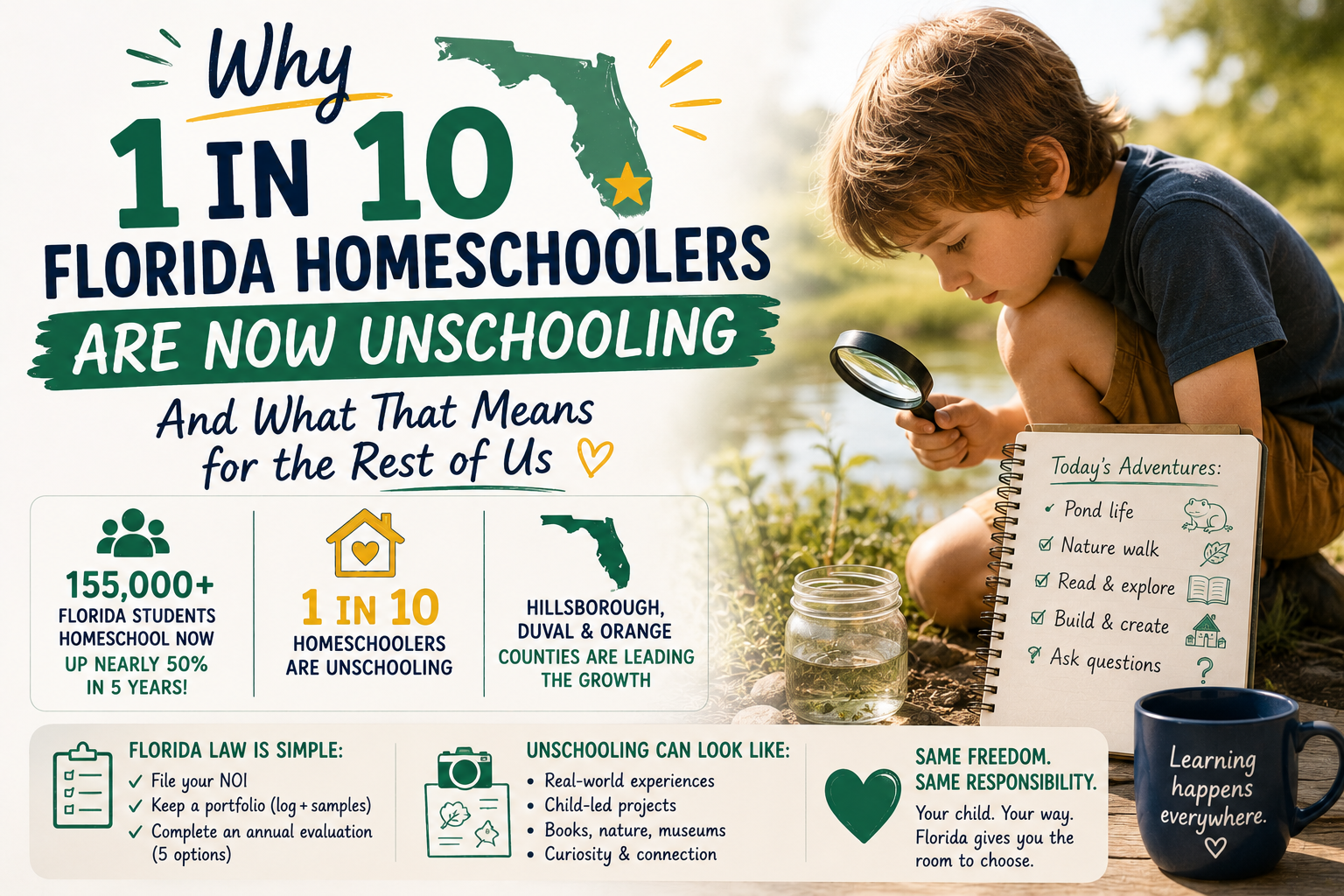
Why 1 in 10 Florida Homeschoolers Are Now Unschooling — And What That Means for the Rest of Us
If you've been homeschooling in Florida for more than a year or two, you've probably noticed it: more neighbors at the park on Tuesday mornings, longer waitlists for co-ops, busier library story times. You're not imagining it. Florida's homeschool community has grown nearly 50% in five years, with more than 155,000 students now learning at home. And tucked inside that growth is a quieter shift that's worth paying attention to: roughly 1 in 10 Florida homeschoolers are now unschooling.
If that word makes you nervous — or curious — this post is for you. Let's unpack what it means, why Florida's law happens to make unschooling unusually doable here, and (most importantly) what it does not change about your responsibilities as a registered home education family.
First, what "unschooling" actually means
Unschooling is an interest-led, child-directed approach to learning. Instead of following a boxed curriculum with daily lesson plans, unschooling families let learning grow out of the child's questions, projects, reading choices, and real-world experiences. A kid obsessed with frogs might spend three weeks deep in pond biology, art, and field journals — and never crack a textbook called "Science 4."
It's not "no school." It's "no school for this approach
Here's where Florida's design really shines. Our home education law (FS 1002.41 — the statute that governs home education programs) doesn't dictate how you teach, what curriculum you use, or which hours you keep. It asks for a few specific things:
- A Letter of Intent (often called the NOI — Notice of Intent) filed with your district when you start homeschooling.
- A portfolio — defined in the statute as a log of educational activities and samples of your child's work.
- An annual evaluation, with five options to choose from (more on those in a moment).
That's the framework. The statute doesn't tell you to follow B.E.S.T. or NGSSS standards (the state's academic benchmarks used in public schools). Home education families are free to use them, ignore them, or borrow from them — your call. That flexibility is exactly what makes unschooling possible here, in a way it might not be in heavier-regulation states.
What an unschooling portfolio can look like
This is the part that trips people up. "If we don't use curriculum, what goes in the portfolio?"
Per Florida law, your portfolio needs two basic things:
- A log of educational activities (titles of books read, topics explored, places visited, projects completed).
- Samples of materials and the child's work from the year.
For an unschooling family, that log might include:
- Library books read aloud or independently
- Documentaries and educational YouTube channels watched
- Museum visits, nature center trips, historical sites
- Cooking projects (yes, fractions and chemistry count)
- Journal entries, drawings, photos of builds and experiments
- Conversations and questions the child pursued
- Volunteer hours, 4-H, scouting, sports
Samples can be photos of a Lego city, a page from a nature journal, a printed-out story your child dictated, a screenshot of a coding project. The statute says "samples" — it doesn't say "worksheets."
The five evaluation options (the part that keeps families up at night)
Florida gives you five ways to satisfy the annual evaluation requirement:
- A certified teacher reviews the portfolio and discusses progress with the student.
- The student takes a nationally normed standardized test administered by a certified teacher.
- The student takes a state student assessment test used by the school district.
- The student is evaluated by a licensed psychologist using a state-approved test.
- Any other valid measurement tool mutually agreed upon by the parent and district superintendent.
For unschooling families, option 1 is usually the natural fit — a certified teacher-evaluator reviews your portfolio and talks with your child. There's no minimum score, no grade level to hit. The evaluator's job is to determine whether your child made progress "commensurate with their ability." That's the legal language. It's a gentle bar, intentionally.
The county context
The growth isn't evenly spread. Hillsborough, Duval, and Orange counties are leading homeschool enrollment in the state. If you live in one of those areas, you probably already feel it — more co-ops, more meetups, more evaluators to choose from. That density is part of why alternative approaches like unschooling have room to flourish here.
What this does NOT change
Deep breath.:
- Your legal requirements are exactly the same. NOI, portfolio, annual evaluation. That's it.
- You don't have to change your approach because other families are unschooling. Boxed curriculum is still completely valid in Florida.
- The portfolio standard hasn't shifted. A log plus work samples. Whether your samples are math worksheets or pond-mud photos, the requirement is identical.
- Evaluators aren't comparing your kid to anyone else's. The evaluation is about your child's progress.
The rise of unschooling isn't a referendum on how you homeschool. It's just a reflection of how flexible Florida's law has always been — and more families are realizing it.
The takeaway
Whether unschooling appeals to you or sounds like chaos, the headline here is that Florida's home education law gives families room to choose. That's the design. The statute is short. The requirements are concrete. And the portfolio — whatever shape it takes — is the through-line that connects every approach.
This post is not legal advice. Statutes and district practices change; please verify current requirements with your county home education office or read FS 1002.41 directly. When in doubt, check with your district.
Want to build your portfolio a little each day instead of scrambling in May? Start a free trial of The Homeschool Portfolio and see how easy a "log + samples" approach can be.