Florida Homeschoolers & the $1,700 Federal Tax Credit (2027)
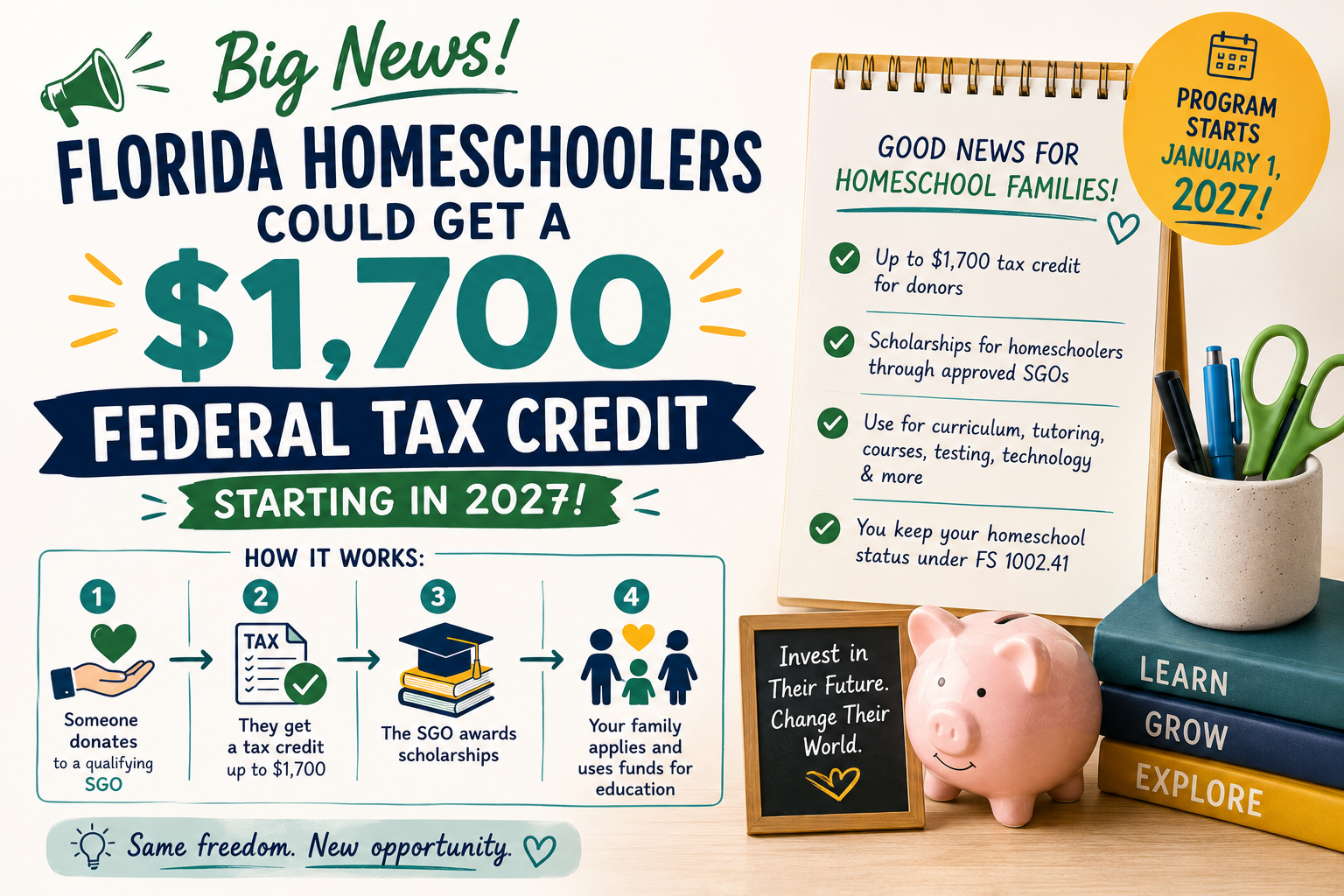
Big News: Florida Homeschoolers Could Get a $1,700 Federal Tax Credit Starting in 2027 — Here's How It Works
If you've seen the headlines about a new $1,700 federal tax credit for homeschoolers and thought, "Wait — is this for me? Do I have to apply? Will it mess up my homeschool status?" — you're not alone. I've gotten so many texts from fellow Florida homeschool moms this month that I figured it was time to sit down and write out what we actually know so far, in plain language.
Take a breath. This is good news. And you have plenty of time to figure it out before it kicks in on January 1, 2027.
What was announced?
In January 2026, Governor DeSantis announced that Florida is opting in to the federal Education Freedom Tax Credit, a program created by the One Big Beautiful Bill Act. Florida is one of 23 states participating. The program officially starts January 1, 2027.
The headline number — a credit of up to $1,700 — sounds straightforward, but the mechanics are a little weird at first glance. Let me walk you through it the way I had to walk myself through it.
How the credit actually works (in plain English)
Here's the part that confuses everyone: the $1,700 credit doesn't go directly to homeschool families. It goes to taxpayers (individuals, possibly businesses) who donate to qualifying Scholarship Granting Organizations — let's call them SGOs. spend on approved education expenses.
So the flow looks like this:
- A taxpayer donates to a qualifying SGO.
- That taxpayer gets a federal tax credit of up to $1,700 for the donation (a credit, not a deduction — meaning it comes off their tax bill dollar-for-dollar).
- The SGO awards scholarships to eligible students, including homeschoolers.
- Your family applies to an SGO and, if awarded, uses the funds for qualifying education expenses.
In other words, you're not filing for a $1,700 credit on your own taxes. You're applying to an SGO for scholarship money that was generated by other people's donations.
Who will qualify?
Based on what's been announced so far, the program is designed to be broadly available — it isn't strictly income-capped the way some scholarship programs are, though SGOs may set their own priorities. Florida has indicated it wants homeschoolers included alongside private school students. That's a meaningful win, because not every state's program treats homeschoolers as eligible.
That said, the specific eligibility rules, application windows, and approved SGOs in Florida are still being finalized. Expect more concrete guidance in late 2026.
What expenses will likely qualify?
Federal guidance points to the same types of education expenses you'd expect from a scholarship program:
- Curriculum and textbooks
- Tutoring
- Online courses and educational software
- Standardized testing fees
- Educational therapies for students with disabilities
- Certain technology used for learning
Final lists will come from the SGOs and Treasury guidance. Save your program you end up using.
How does this interact with Florida's existing scholarships?
Florida already has the Family Empowerment Scholarship (FES), which many homeschool families (technically operating as "Personalized Education Program" or PEP students) use. If you're already on FES-PEP, you may need to choose between programs or follow specific stacking rules. Those rules haven't been published yet for the federal credit.
If you've been a traditional homeschooler under FS 1002.41 — meaning you filed a Letter of Intent (NOI) with your district and you do an annual evaluation — and you've been watching the FES expansion from the sidelines, this new federal credit may be a much simpler entry point. You wouldn't have to switch your homeschool status.
The common misconception to bust right now
"If I take the federal tax credit scholarship, I'm no longer a homeschooler under Florida law."
Not necessarily. The federal program is a funding mechanism, not a re-categorization of your education status. Florida law (FS 1002.41) defines what a home education program is, what you have to file, and what you have to keep. The federal credit is separate from that.
The big watch-out: when you accept scholarship funds, you usually take on some reporting requirements to the SGO (receipts, expense categories, etc.). That's not the same as losing your home education status — but it's not nothing, either. Once Florida publishes the rules, we'll know exactly how the two interact.
What the law does NOT require
Let's pull the anxiety down a notch. As of right now:
- You are not required to participate. This is opt-in. If you'd rather keep your homeschool simple and self-funded, nothing changes for you.
- You don't have to register early. The program doesn't start until January 1, 2027.
- Your annual evaluation requirements aren't changing. Under FS 1002.41, you still pick from the five evaluation options (certified teacher review of a portfolio, nationally normed test, state student assessment test used by the district, evaluation by a licensed psychologist, or any other method mutually agreed upon by the parent and district superintendent).
- Your portfolio rules aren't changing. You still keep a log of educational activities and samples of your child's work, preserved for two years.
- B.E.S.T. and NGSSS standards still aren't mandatory for homeschoolers. You can use them as a reference if you want, but Florida home education law does not require you to follow state standards.
Florida's home education law is intentionally low-regulation. A new federal funding stream doesn't change that.
How to prepare between now and 2027
You don't need to do anything dramatic. But here are some low-effort moves:
- Keep filing your NOI and doing your annual evaluation as usual.
- Start saving receipts for curriculum, tutoring, testing, and educational tech in 2026 — even if the credit doesn't start until 2027, getting in the habit helps.
- Build your portfolio steadily throughout the year instead of scrambling in May. (This is the whole reason I use The Homeschool Portfolio — small daily logs add up.)
- Watch for the list of approved Florida SGOs in late 2026.
- Sign up for updates from your district and the Florida Department of Education.
A soft landing
If keeping up with your portfolio and annual evaluation feels like the part that's stressing you out — not the future tax credit — that's exactly what we built The Homeschool Portfolio for. A few minutes a day during the year, and your year-end evaluation portfolio is basically done. You can start a free trial here whenever you're ready — no pressure, no credit card needed.
This post is for general information only and is not legal or tax advice. Statutes, regulations, and program rules change — especially with a brand-new program like this one. Before making decisions, please verify the current rules with your local school district, a qualified tax professional, and the actual text of FS 1002.41 and the relevant federal guidance.