The 5 Florida Homeschool Evaluation Options, Explained Calmly
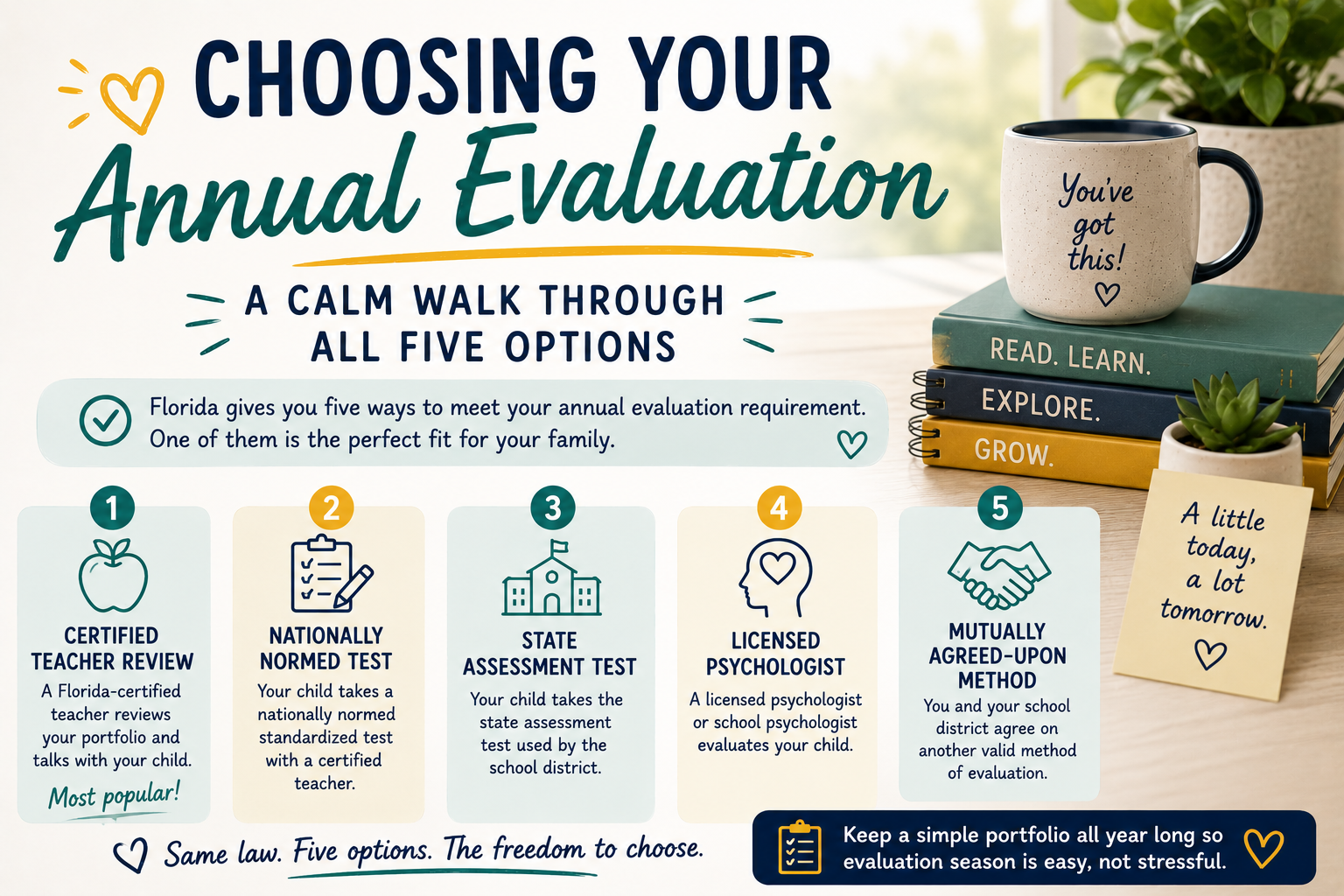
Choosing Your Annual Evaluation: A Calm Walk Through All Five Options
If you're new to homeschooling in Florida — or even if you've been at this for years — the phrase "annual evaluation" can make your shoulders climb up to your ears. Take a breath. Florida is a low-regulation homeschool state by design, and the evaluation requirement is far less burdensome than most parents fear. You have five legal options, and one of them almost certainly fits your family.
Let's walk through them together, the way I'd explain it to a friend over coffee.
First, the Big Picture
Under Florida Statute 1002.41 (the law that governs home education in our state), if you've filed a Letter of Intent (often called an NOI — "Notice of Intent") with your county superintendent to operate a home education program, you're required to do two main things each year:
- Maintain a portfolio of records and materials for your child.
- Submit an annual educational evaluation to your school district.
That's the core of it. No standardized testing requirement (unless you choose that option), no curriculum approval, no teaching credentials required. Just a portfolio and an annual evaluation.
Quick definition: A portfolio in Florida just means a log of educational activities (reading list, subjects covered, et available to the superintendent if requested with reasonable notice.
The Five Evaluation Options
Here's where families get to choose what fits their child best. Per FS 1002.41, you may select any one of the following:
Option 1: Evaluation by a Florida-Certified Teacher
A Florida-certified teacher reviews your portfolio and conducts a discussion with your child to determine that the student is making educational progress "commensurate with his or her ability."
Best for: Families who want a relaxed, conversational review without testing. This is by far the most popular option in my circles. The evaluator writes a short letter, you submit it to the district, done.
Heads up: Costs and availability vary — ask in local homeschool groups for recommended evaluators in your area.
Option 2: Nationally Normed Standardized Test
Your child takes a nationally normed student achievement test (like the Iowa, Stanford 10, or similar) administered by a certified teacher.
Best for: Families who want measurable benchmarks, or whose kids handle test settings well. Also useful if your student is heading toward dual enrollment or wants practice with formal testing.
Option 3: State Student Assessment Test
Your child takes a state student assessment test used by the school district, at a location designated by the district.
Best for: Families already aligning to B.E.S.T. Standards (Benchmarks for Excellent Student Thinking — Florida's current academic standards in ELA and math) or NGSSS (Next Generation Sunshine State Standards, still used for science and social studies). Honestly, this is the least-used option among the homeschoolers I know, but it exists.
Option 4: Evaluation by a Licensed Psychologist or School Psychologist
A psychologist licensed under Florida law (or a school psychologist) evaluates your child using a tool of their choice.
Best for: Families whose child is already seeing a psychologist for assessment, or families with twice-exceptional learners where a professional eval makes sense anyway.
Option 5: Mutually Agreed-Upon Method
You and the district superintendent agree on another valid method of evaluation.
Best for: Unique situations. This option is rarely used because options 1–4 cover most needs, but it's there if you have a specific reason to negotiate something different.
How to Choose
Here's the honest truth: most Florida homeschool families pick Option 1. A certified-teacher evaluation is low-stress, child-friendly, and produces exactly what the district needs — a signed letter affirming progress.
But here's how I'd think about it:
- Anxious tester / young child / first-year homeschooler? → Option 1.
- Goal-oriented family who likes data? → Option 2.
- Child who genuinely thrives on standardized tests, or who you suspect needs documentation for future scholarship/college purposes? → Option 2 or 3.
- Already working with a psychologist? → Option 4 might double up for you.
- Something unusual going on? → Talk to your district about Option 5.
When Is It Due?
Your evaluation is due to the district annually, on or before the anniversary of when you filed your Letter of Intent. So if you filed in August, your evaluation is due the following August. (Verify your exact deadline with your county's home education office — districts sometimes have specific submission instructions.)
If your child isn't showing progress, the law provides a **probationary year will not end your homeschool. Florida really does give families room to breathe.
Start Your Portfolio Now (Future You Will Thank You)
The single biggest favor you can do for evaluation season is build your portfolio a little at a time rather than scrambling the week before. A reading list updated weekly, work samples saved monthly, and a simple log of subjects covered will make any of the five options dramatically easier.
When evaluation day comes, you want to walk in (or hit "send") with a tidy, organized record — not a shoebox of crumpled worksheets and a panic attack.
A quick reminder: I'm a homeschool parent, not an attorney. Florida statutes can change, and districts sometimes interpret submission details differently. Always verify current requirements at fldoe.org, read FS 1002.41 directly, or contact your county's home education office before making compliance decisions.
If keeping your portfolio organized feels like one more thing on a too-long list, that's exactly why we built The Homeschool Portfolio — to help Florida families add a little to their portfolio each day, so evaluation season feels like a victory lap instead of a fire drill. Start a free trial whenever you're ready. No pressure, no credit card surprises.
You've got this. Florida homeschooling is more flexible than it looks.