FES Funds Expire June 30: How to Spend Them Wisely
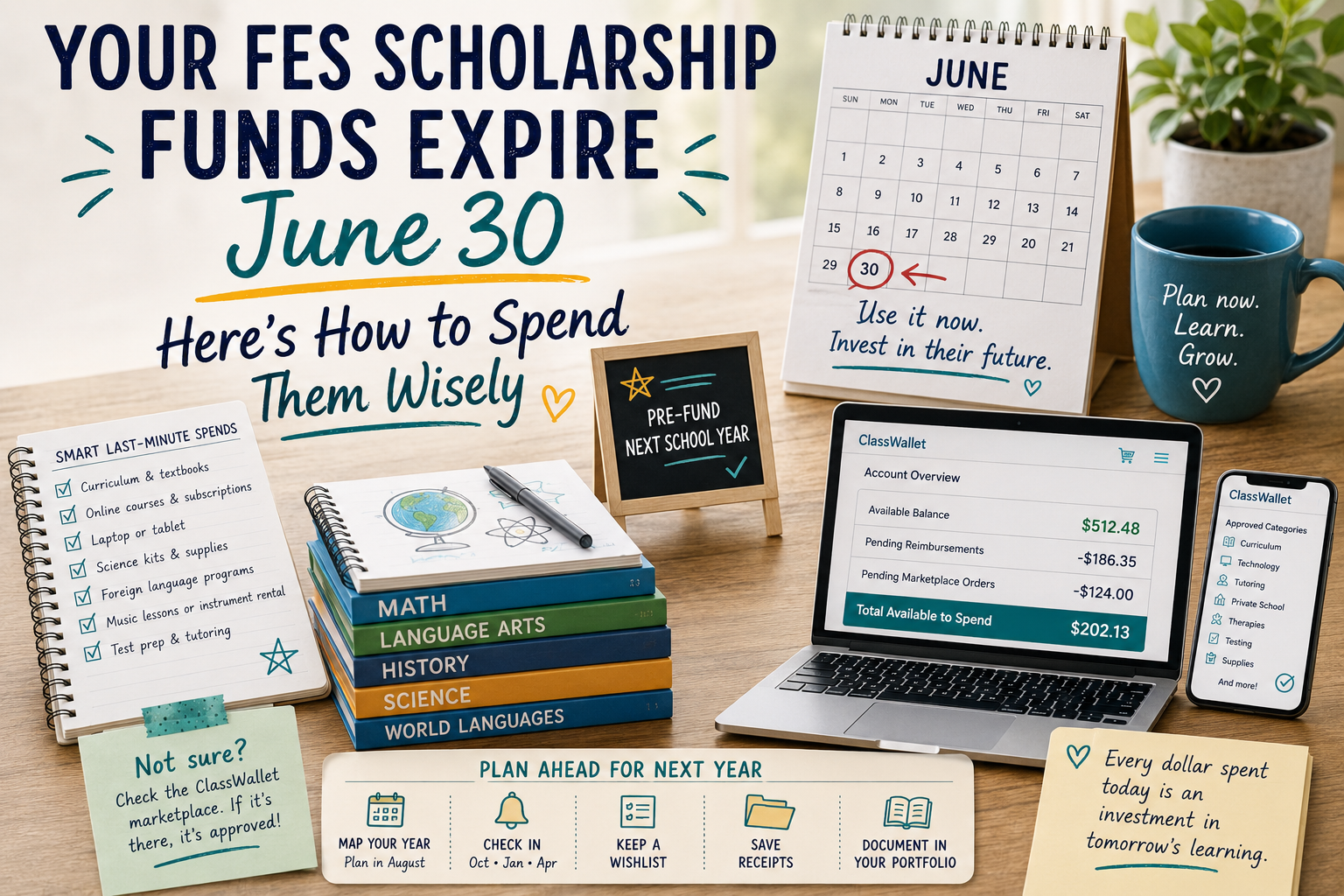
Your FES Scholarship Funds Expire June 30 — Here's How to Spend Them Wisely
If you're logging into ClassWallet this week with a knot in your stomach because there's still a chunk of money sitting in your child's Family Empowerment Scholarship (FES) account — take a breath. You're not the only one. Every June, Florida homeschool parents scramble to figure out what's "approved," what's worth buying, and whether they're about to lose hundreds (or thousands) of dollars on June 30.
Let's walk through it calmly.
First, the basic worry: "Do my FES funds really disappear?"
Short answer: yes, unspent FES-PEP (Personalized Education Program) funds generally do not roll into the next fiscal year. The state's fiscal year ends June 30, and balances are typically swept back into the program's general pool. That's the headline. But "spend it or lose it" doesn't have to mean "panic-buy a robot you don't need."
A more useful frame: you have about three weeks to convert remaining dollars into things your family will actually use during the next 12 months of learning.
Step 1: Check your balance (and your pending transactions)
Log into your ClassWallet parent dashboard. Look at three numbers:
- Available balance — what you can still spend.
- Pending reimbursements — money you. This counts against your balance.
- Pending marketplace orders — items already in process.
If you submitted reimbursement requests recently, don't double-count. Subtract pending amounts from your available balance to see what you can truly still spend.
Step 2: Know what's actually approved
The FES-PEP approved-use categories (per Step Up For Students guidance) generally include:
- Curriculum and instructional materials — textbooks, workbooks, online courses, teacher guides aligned to B.E.S.T. or NGSSS standards (B.E.S.T. = Benchmarks for Excellent Student Thinking; NGSSS = Next Generation Sunshine State Standards — Florida's academic standards).
- Tutoring services from approved providers.
- Educational technology — laptops, tablets, certain software, printers (with category limits).
- Part-time enrollment at participating private schools or programs.
- Specialized therapies (for FES-UA students with documented needs).
- Tuition for approved educational programs, including some FLVS Flex options.
- Standardized testing fees and tutoring for tests.
- Curriculum-aligned supplies like art materials, science kits, manipulatives.
What's typically not approved: general household items, non-educational toys, snacks, furniture not classified as educational, streaming entertainment subscriptions, and most extracurricular activities that aren't tied to instruction. When in doubt, search the ClassWallet marketplace first — if it's there, it's approved.
Step 3: Smart last-minute spends (not just stents tend to get the most mileage:
- Next year's full curriculum. If you already know you're using Math-U-See, Saxon, BookShark, Memoria Press, or any boxed curriculum next fall, buy it now. It doesn't expire.
- Online course enrollments for fall semester (Outschool packages, IXL annual subscriptions, Reading Eggs, etc.) — many can be purchased now and activated later.
- A reliable laptop or tablet if your current device is limping. This is a category many parents underuse.
- Microscope, telescope, or science kit tied to next year's science scope and sequence.
- Foreign language programs (Rosetta Stone, Duolingo Family, Mango) — often year-long subscriptions.
- Music lessons or instrument rental through an approved provider.
- Test prep materials for upcoming standardized testing — especially relevant if you plan to use the nationally-normed test option for your annual evaluation.
A small mindset shift: you're not "spending leftover money," you're pre-funding next school year.
The common misconception worth busting
A lot of parents believe: "If I don't spend every dollar, I'll get a smaller award next year."
That's not how the allocation works. Next year's award amount is set by the Legislature and program rules — not by your personal spending velocity. Leaving $300 on the table in June doesn't shrink your fall award. It just means $300 went back to the pool instead of into your homeschool. So spuse it up."
What Florida law does NOT require
Since The Homeschool Portfolio exists to help families with their year-end evaluation, this is worth saying clearly. Under Florida Statute 1002.41 — Florida's home education statute — you are not required to:
- Spend any FES funds at all (the scholarship is optional; you can homeschool without it).
- Submit receipts or purchase logs to your school district.
- Prove your FES spending lines up with your portfolio.
- Use a specific curriculum or follow B.E.S.T./NGSSS standards (those standards are useful guides, not mandates for home educators).
- Test in any particular subject — you choose from the five annual evaluation options.
The FES program has its own rules (administered by Step Up For Students). Your home education file with the district — your Letter of Intent (NOI), your portfolio, and your annual evaluation — is a separate track. Don't conflate the two. A district contact will never ask to see your ClassWallet history.
Planning better for next year
A few habits that make the next cycle calmer:
- Map your year in August. Write down curriculum, subscriptions, and big-ticket items you anticipate. Submit those reimbursements or marketplace orders early.
- Set a "check-in" calendar reminder for October, January, and April. Look at your balance. Adjust.
- Keep a running wishlist in a notes app — when you have leftover funds in spring, you're not staring at a blank screen.
- Save digital copies of receipts in a folder by school year. Even though the district doesn't ask, it makes your own bookkeeping painless.
- Document curriculum purchases in your portfolio as you go. A book bought with FES funds can absolutely appear in your portfolio sample work — it's still your child's learning.
A soft nudge before you go
If the portfolio piece feels like the next thing on your worry list, that's exactly what The Homeschool Portfolio is built for — a few minutes a day, all year, so May doesn't feel like a fire drill. You can start a free trial whenever you're ready, no pressure.
This post is written by a Florida homeschool parent, not an attorney or a Step Up For Students representative. Statutes, program rules, and approved-use lists change. Please verify current FES-PEP guidance with Step Up For Students and ClassWallet, and confirm home education requirements with your county district contact or by reading FS 1002.41 directly.